
Written by Steven Judge, Founder of GameLayer
When people first explore gamification, the challenge is rarely understanding the concept. Most teams already know what challenges, XP, achievements, and rewards are supposed to do.
The harder part is visualising how those mechanics actually behave when they're wired up to a real system.
That's what GameLayer Assets is designed for.
Not as a deep engagement experience.
Not as a complete product.
But as a simple, visual way to see individual gamification mechanics working in practice.
What GameLayer Assets Is — and What It Isn't
Let's be clear about the intent.
GameLayer Assets is not a full engagement journey. It doesn't attempt to model long-term retention, sophisticated progression curves, or complex behavioural loops. It's intentionally lightweight.
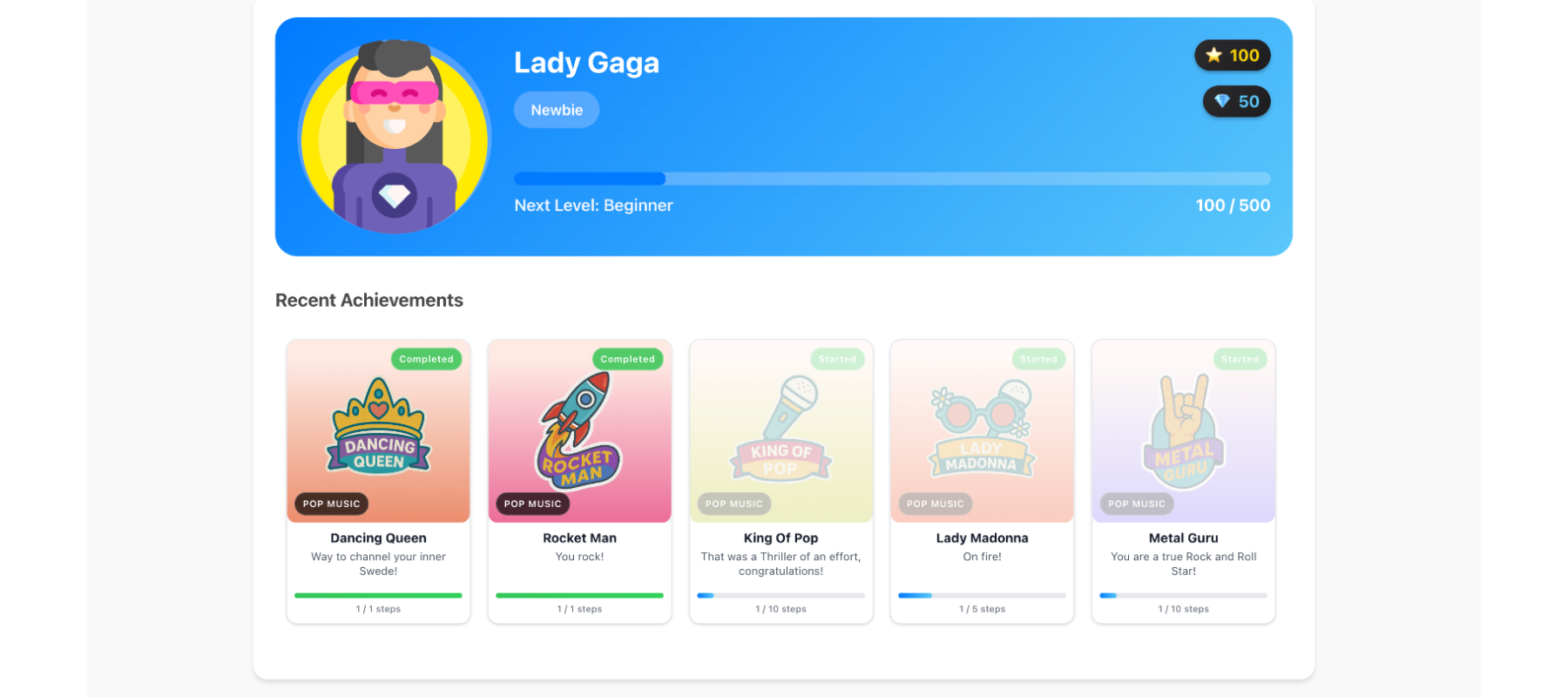
What it does do is showcase core gamification mechanics — challenges, XP, progression, rewards — in a way that's immediate and easy to understand.
Think of it as a mechanics playground, not a final end-to-end experience.
If you've ever looked at gamification APIs and wondered:
- "What does this actually look like?"
- "How do these mechanics surface visually?"
- "How do they respond when something changes?"
This page exists to answer those questions quickly.
Powered by GameLayer — Not a Mock
One important thing to stress: this is not a mock-up or a simulated demo.
The assets page is powered by GameLayer itself.
Behind the scenes:
- There is a real GameLayer account
- The UI is making real API calls
- The data you see is real data flowing through the platform
- Changes reflect actual state updates, not hardcoded examples
This matters, because it means what you're seeing is representative of how the platform behaves when integrated into a real product — just stripped back to the essentials.
The UI is intentionally simple. The mechanics are real.
Assets You Can Download and Reuse
Another important detail: everything you see on the assets page is available to download and reuse.
The visuals, components, and example assets aren't locked away as a demo. They're there to help teams get started faster — whether you're prototyping, building a proof of concept, or wiring up your first real integration.
Rather than starting from a blank canvas, you can take these assets and adapt them to your own product, your own UI, and your own context.
Where This Fits in Your Build Process
This page isn't meant to replace proper design or discovery work. Instead, it fits before implementation.
It's most useful when:
- You're exploring whether gamification makes sense for your product
- You want a shared reference point across product, design, and engineering
- You're validating assumptions before committing to a build
- You want to move from abstract discussion to something concrete
It's a starting point — not a blueprint.
Making Gamification More Concrete
Gamification often fails because it stays abstract for too long.
Teams debate mechanics conceptually, but never get a shared understanding of how they behave in reality. By the time something is built, expectations don't match outcomes.
GameLayer Assets is a small step toward fixing that.
It makes gamification visible, interactive, and grounded in real systems, while also giving teams something tangible they can reuse when they're ready to build.
Want to see real gamification mechanics powered by a live API?
Explore the GameLayer Assets sandbox. Explore now →
Sign up free