Location-based loyalty: how check-in missions work
Location-based loyalty rewards members for being somewhere, not just for spending something. A check-in mission ties a goal to a real place — a store, a venue, an event — and when the member's phone confirms they are there, the mission completes and the reward follows.
That simple idea changes what a loyalty programme can see and reward. This guide explains how check-in missions work, how to set them up so genuine visitors succeed and casual cheaters don't, and where they fit alongside the rest of your programme.
Why does location-based loyalty matter?
Most loyalty programmes only notice members at the till. A visit that doesn't end in a purchase is invisible, even though for many businesses the visit is the thing they need most.
Retailers want people through the door. Venues and events want them to arrive early, stay longer and visit sponsors. Lottery and gaming operators want members at their retail partners. Tourism boards want people to explore beyond the obvious sights. In each case, footfall comes before revenue.
Location-based loyalty lets you reward that behaviour directly:
- A reason to visit between purchases. Members earn progress, status or a chance to win just by showing up.
- Discovery. Point members towards a new store, a quieter location or a partner venue they haven't tried.
- A real-world habit loop. Weekly visit streaks and seasonal trails give people a reason to come back on a rhythm.
- Better insight. You learn which locations and which missions actually move people, not just which ones sell.
The effect can be significant. When Veikkaus, Finland's national lottery and gaming operator, added location missions to its loyalty programme as "Veikkaus Check Points", the programme saw 35% more app sessions attributed to those missions.
How does a check-in mission work?
Every location-based mission has four parts:
- A place. A point on the map — the coordinates of a store, venue or landmark.
- A view radius. How close a member must be to see the mission in your app.
- An action radius. How close they must be to complete it. It is always smaller than or equal to the view radius.
- A rule. What the member has to do, how often they can do it, who is eligible and what they get.
Here is what happens when a member uses it:
- Your marketing team creates the location and the mission in the dashboard and publishes it. No app release is needed.
- The member opens your app. The app sends their current position, and the platform returns the missions they are close enough to see.
- The member walks in. Once they are inside the action radius, the app lets them check in and sends the check-in with their coordinates.
- The platform checks the distance, the member's eligibility and any claim limits. If everything passes, it awards the reward and counts the visit towards any streaks, achievements or levels it feeds.
The two radii do different jobs, and getting them right matters more than anything else.
| View radius | Action radius | |
|---|---|---|
| Purpose | Awareness: "there's something for you nearby" | Proof: "you are actually here" |
| Typical size | From around 1 km for a city walking app to several kilometres for a regional campaign | From as tight as 25 m for a single venue entrance to the full footprint of a large site |
| What the member sees | The mission appears in the app, with directions | The check-in button becomes active |
| Set it too small and… | Nobody discovers the mission | Genuine visitors can't check in |
| Set it too large and… | The app fills with irrelevant offers | People claim from the car park or the next street |
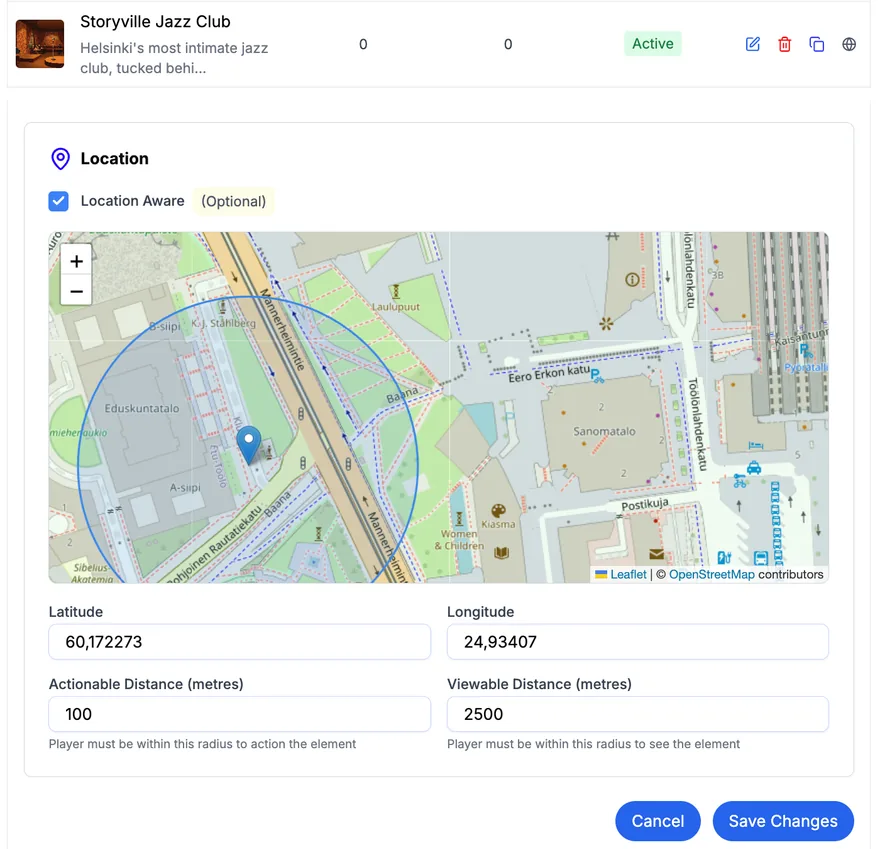
In the example above, a jazz club mission becomes visible to members within 2.5 km, which is enough to draw people in from across the city centre. They can only complete it within 100 metres of the door.
There is no single right setting. The radii depend on the venue and on what you want members to do. A city walking trail might show each stop only within 1 km so the next one feels like a discovery, while a mission at a stadium gate can use an action radius as tight as 25 metres.
What does it look like in practice?
Check-in missions work across very different businesses. A few patterns that work well:
- Retail. "Visit any three of our stores this month" earns an achievement badge. A new store opening gets a one-off mission with a mystery prize for the first visit.
- Venues and events. A festival trail asks fans to check in at five stages over a weekend, with a raffle entry for completing it. Sponsors get their own stop on the trail.
- Cities and tourism. ROAM Helsinki is a live demo built on GameLayer: people explore the city and collect a location card at each place they visit.
- Lottery and gaming. Veikkaus Check Points brought the loyalty programme into the real world. Each Check Point was a place that mattered to Veikkaus: sports and cultural venues among the many beneficiaries its lottery proceeds support. Members learned about the venue and Veikkaus's role in it, and earned a virtual reward for visiting. Some Check Points also held a mystery box with real-world rewards to collect on site. What surprised us most was simply how much engagement these missions attracted.
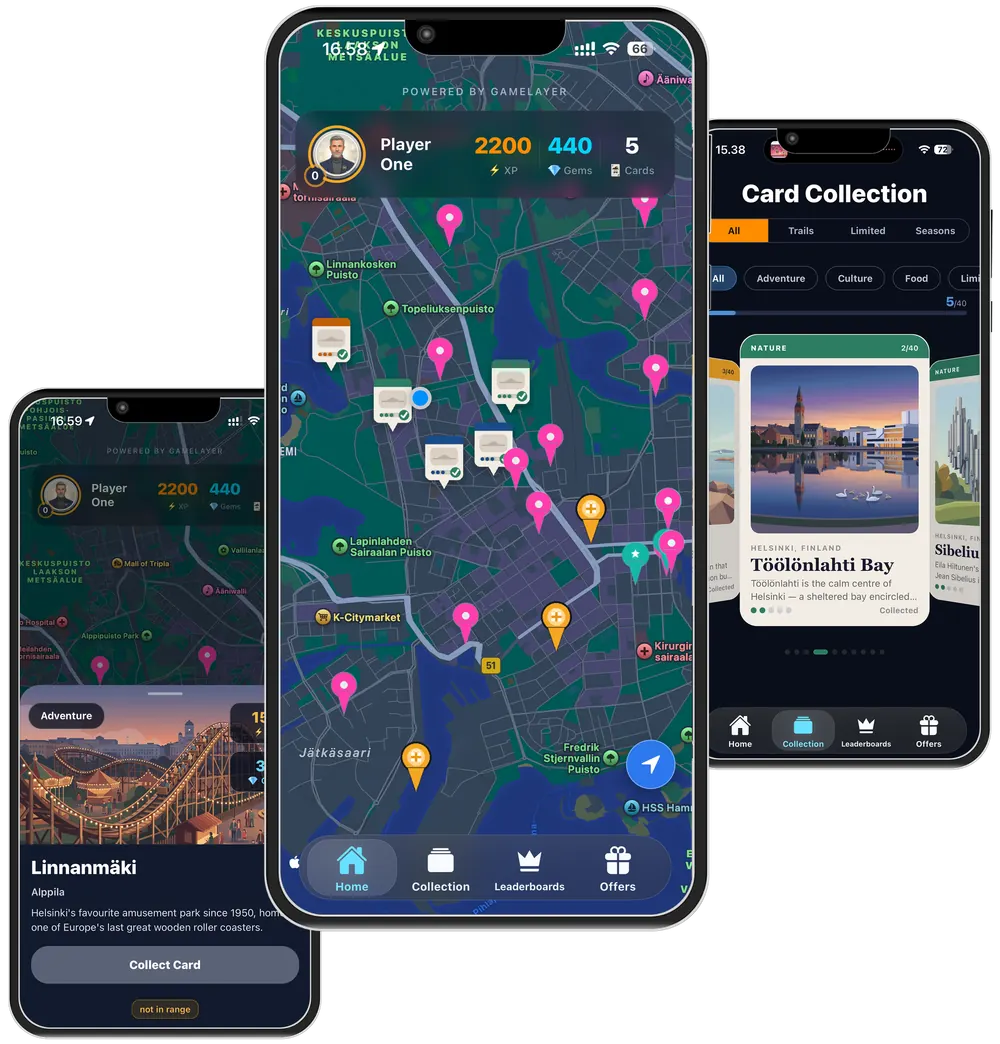
Location becomes most powerful when it combines with other mechanics rather than standing alone:
- Streaks: a weekly visit streak turns an occasional customer into a regular one.
- Mystery wins: a chance of a surprise prize on every check-in keeps the moment exciting without a discount on every visit.
- Raffles: entry only available on site, ideal for events and launches.
- Leaderboards: rank members, teams or cities by visits during a campaign.
- Collections and achievements: permanent proof of where someone has been, which people are surprisingly keen to complete.
For a fictional but fully worked example, see our retail loyalty example programme, which mixes community events, visits and online actions.
What are the common mistakes?
Most problems with location-based loyalty come from a handful of avoidable decisions.
An action radius that's too tight for the site. Tight radii work well for a clearly defined spot, such as an entrance or a landmark. But phone positioning is far less precise indoors and between tall buildings, so a tight radius around a large store can reject genuine visitors standing at the till. Match the radius to where members will actually be when they check in.
An action radius that's too wide. The opposite problem: members check in from the car park, the bus stop or the café next door. Collect the reward without the visit often enough and the mission stops doing its job.
No claim limits. Without per-member limits and a gap between claims, one determined member can check in again and again. Decide how often each person can be rewarded (once a day, once a week, once per campaign), how long before a mission can be started again, and an overall budget for the rewards it gives away.
Ignoring location spoofing. Some people use apps that fake their phone's position. The answer is to make it pointless: cap how many check-in events count for each member, limit how many times a mission can be completed, keep each check-in reward modest, and ask for a second proof, such as a code shown in store, before releasing anything valuable.
Paying for every visit with discounts. If each check-in earns money off, you are buying footfall at a margin you'll struggle to sustain. Status, progress, collectibles and the occasional mystery prize create the same pull for far less.
Making location the whole programme. Not every member can visit regularly. Use location missions as one part of a programme that also rewards online engagement, so members who live further away still have a way to take part.
Forgetting time. Missions tied to events or opening hours need start and end dates, and members in different time zones experience "today" differently. Schedule missions so they're only available when a visit is actually possible.
Should you build it or use a platform?
Checking whether a phone is inside a circle is a few lines of code. Running a location programme is not.
Once real members are involved, you need view and action radii per location, claim limits, reward budgets, eligibility rules, schedules, seasonal refreshes and reporting — and your marketing team needs to change all of it without waiting for a developer. That ongoing operational work is where in-house builds usually stall.
This is the problem GameLayer was built for. Missions, prizes, mystery boxes and raffles can all be made location-aware, each with its own view and action radius. Your team adds locations and missions in the dashboard, and the controls that stop people gaming the system come built in: limits on how many events the platform records per member, on how many times a mission can be completed, and on how often a reward pays out to the same person (daily or weekly, for example), plus a cooldown before a mission can restart. Eligibility rules and reward budgets sit alongside them. Your developers integrate once: the app sends the member's position when it fetches missions and when it checks in, and the platform does the rest. If you're weighing up the build-or-buy question more broadly, our guide to what a gamification API is and when you need one covers it, and the full technical details are in our API reference.
If you want to see what that feels like from the member's side, try ROAM Helsinki. To set up your own first location mission, check our pricing and request a free trial.
Frequently asked questions
What is a check-in mission?
A check-in mission is a loyalty goal tied to a real place. The member completes it by being physically at that location — a store, venue or event — and checking in through your app. The platform confirms they are within range, then awards the reward.
How accurate does phone location need to be?
It depends on the site. An action radius can be as tight as 25 metres for a clearly defined spot such as a venue entrance, but positioning is less precise indoors and between tall buildings, so large sites need a wider radius. Use per-member limits, not just a tiny radius, to stop abuse.
Can members fake their location?
Some can, with location-spoofing apps, so the programme should make it pointless. Cap how many check-in events count per member, limit how often a mission can be completed and how often a reward pays out to the same person, and ask for a second proof, such as a code shown in store, before releasing high-value rewards.
Do members have to share their location all the time?
No. The loyalty platform only sees a position when your app sends one, typically when the member opens the app or taps to check in. Background tracking is a separate choice for your app, and most programmes don't need it.
Do I need a native app for location-based loyalty?
No. Any app or website that can read the device's location with the member's permission can send it with the check-in. Native apps give a smoother experience, but a web app works for a pilot.
See it running in your programme
30-day free trial for up to 1,000 active users. No credit card.